Thursday, November 17, 2005

Chance (Castellano aqui)

Yosuke and Kana love each other, but they don’t know it. As he clumsily alights the tram, his jacket is caught on the railing next to the window, making him lose his step. He falls out of the door and bangs his leg on the metal rung, under the coldly astonished gaze of the conductor. But it is not hard concrete what awaits him below. Instead, her left side stops his fall on the crowded platform. Unwillingly, of course. Shit.

Startled, Kana yelps briefly. People around her look in cold astonishment. Yosuke is mortified, so he laughs out loud. He bows and apologises to Kana, who is also laughing and secretly trying to suppress the pain from the shock on her left side. Of course she’s fine, she replies. As he secretly whimpers, sobbing his shin, Yosuke thinks he was lucky to fall on her and not a businessman on amphetamines. He is not much of a fighter.

Two weeks later, they will meet again, this time in a lift at the department store. He needs to get new strings for his mandolin on the top floor, and she needs some plastered bandage to make a mask. They fail to recognize each other at first, but their memory is refreshed as soon as the lift becomes crowded and she slightly bumps into his left side. She yelps again, this time in surprise, and he smiles awkwardly. No, no, I’m the one who’s sorry for that time. Out shopping? My floor. Maybe I’ll bump into you again sometime.

And so they met once more, at a bar one Friday evening after work. He was putting up with an office party, she was out with friends. They happened to sit on opposite tables. Yosuke noticed Kana as she peeled another soybean pod, though he wasn’t sure if he should say hello. Mere politeness, that’s all. I think she saw me.

Their eyes meet, and he bows awkwardly. She smiles and waves. I hope I don’t have bean skin on my teeth. They’re both trapped with their respective companions, him with drunken colleagues, her with good friends, so no one stands up. Once her friend decides it’s time to leave, he bumps into Kana on the way back from the toilet. You’re leaving? I wonder if we’ll keep running into each other like this. Smiles on both sides.

It could happen anytime. A walk in the park by the riverbanks, an intersection in the city centre, the bus stop in front of the bank. As Yosuke walks back home that night thinking if he should take the moped up to the mountains the next day, Kana brushes her teeth and decides that tomorrow she’ll go hiking. Sound asleep, they will both miss the time when spider webs glisten like dewdrops in the first light of the morning.

Friday, November 04, 2005

Life in Venn

Being strewn by circumstance into another country, especially in a culture as segregating as Japan, can be daunting and not always enjoyable. After the thrill of the new wears off, it's easy to get bitter about the less charming aspects of what's foreign to oneself. The result is an almost bipolar relationship with one's host country, alternating between varying extremes of love and hate. Some would say that in Japan it could be easily summed up as "we love them, they hate us."But of course, things are not so simple, nor are they so black and white.

The more one gets accustomed to another culture, remaining a foreigner in the eyes of the host can become annoying. It's a common complaint by most foreigners in Japan (at least the ones who refuse to become
charisma men). Books have been written about it. Sociologists, Psychiatrists and Anthropologists have dedicated volumes to this particular brand of underhanded racism. It would be foolish to believe that it only happens in Japan, though I dare say that here it's far more conspicuous. Institutions are built on the "us" and "them" mentality, a sore remnant of nineteenth century racialism and millenary exposition to Chinese cultural absolutism.

Walking through my local immigration office in a bid to renew my visa (which anyone can attest to as being far from easy), a poster looming over the main counter caught my attention. Colourful and cartoonish, it warned to the recent change in Japanese immigration laws. Indeed, as from 2003 these were tightened to secure an even more draconian approach to illegal foreign workers (and, one could argue, legal ones, too). Bigger fines, longer prison sentences, more paperwork and necessary proof of labour - all these items underlined in pink, with a somewhat stylish lettering and surrounded by horrid childish drawings. At the bottom, a smaller font paragraph claimed that "these laws are to ensure a better co-operation and understanding between Japanese people and foreigners, and to ensure a smooth transition into the effective internationalisation of Japan." It was all managerial-style wank, of course.

While illegal immigrants from poorer Asian countries abound, Japan has revered the time-honoured practice of exploitation for many centuries. Starting with the
burakumin, the Japanese establishment has for centuries found ways to deprive minority groups of citizenship. The legend above is nothing but a testament to deeply-ingrained xenophobia, based on the shaky grounds of an all-pervasive national identity. The herrenvolk still lives within the labyrinthine bureaucracy of the Japanese establishment.

What is the effect of this, then, on a foreigner's ordinary life? Surely not all Japanese are racists - at least not consciously so. Yet a lifetime of being exposed to ideas of racial purity (though oftentimes stripped off its more virulent aspects), converges into feelings of uniqueness: they are not like us, therefore they cannot and will never live like us.
It is common foreigner lore that one can live in Japan for decades, but still have the same conversation over and over again. Perhaps it is a natural result of believing that one is able to define a fellow human being based on where they come from. And though superficial differences may well exist at first, human beings are extremely adaptable creatures. If the outside is inevitably defined by the inside, isn't there a point where the two must inevitably dissolve?

Saturday, October 29, 2005

El Amigo

El Amigo

For a little black humour follow this link to a short script I wrote. (English version to come soon).

Thursday, October 27, 2005

The Better Man

The idealistic fires of my anarcho-syndicalist side have been all but fanned as of late. With every passing day, I get more and more convinced of the futility of money for the sake of it.

I just finished reading a short story by Tolstoy called "The Death of Ivan Illych," and it really struck a nerve with something going around my head lately. At the risk of making this sound like a book report, the character is a lawyer who dies lonely in a rich house, accompanied by his estranged wife and his selfish children, his only pleasure resting his feet on an innocent peasant boy's shoulders to relieve the agony of the illness eating away his life. (It's pretty evident that the Russian realists weren't the chirpiest birds in the nest). And yet, the story is an examination of how Illych's life was over long before that, overdosing on an immoral cocktail of wealth, greed and power. In fact, the character is only redeemed after he acknowleges that his life, albeit pleasant, was not a good one. "But oddly enough none of those best moments of his pleasant life now seemed at all what they had seemed at the time," explains Tolstoy at the turning point of Ivan's illness, who begins a much belated introspection only after admitting to himself that he will die soon. It might be a tad extreme and melodramatic, but who can say this scenario is strange to those who consciously live at the expense of others, forgoing virtue for social standing and a facade of success?

Then there's a Pearl Jam song I really like, mostly due to the lyrics (but also because of its cooky ukelele rhythm):

"Sorry is the fool who trades his soul for a corvette,
Thinks he'll get the girl he'll only get the mechanic.
What's missing? He's living a day he'll soon forget.

That's one more time around. The sun is going down,
The moon is out but he's drunk and shouting,
Putting people down. He's pissing. He's living a day he'll soon forget.

Counts his money every morning. The only thing that keeps him horny.
Locked in a giant house that's alarming. The townsfolk they all laugh.

Sorry is the fool who trades his love for hi-rise rent.
Seems the more you make equals the loneliness you get.
And it's fitting. He's barely living a day he'll soon forget.

That's one more time around and there is not a sound.
He's lying dead clutching Benjamins, never put the money down.
He's stiffening. We're all whistling a man we'll soon forget."

Lastly, there's this arsehole engineer I met at Jeff's bar the other night. He asked me about my job, and when I told him I was a teacher he gave me the most disgustingly condescending smirk. "Oh, so you're still doing /that/" he said, as though I was a complete loser for not getting an 'important' job at a so-and-so 'respectable' company like his. I really felt like bashing his teeth in. I just smiled, however, and proceeded to explain how great it feels to see your students learn things, and how teaching can be a million times more fulfilling than sitting at a desk all day, just so you can get bits of paper to exchange for shiny trinkets.

So much for unimportant jobs.

Sunday, October 23, 2005

The Untree

6:51am. The early minutes after a turbulent few hours of those introspective nights, when one tumbles and turns and pretends to sleep, unconsciously conscious of the changing shades of dawn, clamped away from stupor by delusions of self-absorbed paranoia spawned by imaginary turntables and Marcel Duchamp inside Magritte's non-pipe.

Yesterday I had bought myself a set of watercolours and spent some time making an uninteresting picture of a badly drawn tree. Leafless, it sucks earth from the ground, as though the two were a single peculiar entity, protruding from the brown soil like a pimple or a nipple, or a rotting cauliflower. Among the inexplicable hues there are infinitesimal hints of red and green. The branches are black, and the trunk is of sandy sienna – hence its resemblance to the dirt below. The sky remains unpainted. In my mind it blends with the leaves -the ones that have fallen- and earth and firmament are one; the moon exclaims "Bismillah!" and the tree remains but that, standing passive in the centre and gaping back at me.

So, despite the pretentiousness of baptism, it is now called "the Untree," homage to the silhouette of a Danish madman reflected in the shadows of a cave. It is my tricolour flag of brown, browner and yellow screaming chants of revolution, and the fifty stars that are not there represent all of mankind's sins: sleepiness, insomnia, unruly hair, boils in the mouth. And then, when the bell rings seven times, one will suddenly remember that the sky lingers unpainted and that suddenly it's time for breakfast and that the tree that stands so tall and flat in grainy paper is not, and never was, a tree.

Friday, October 21, 2005

The Perfect Two

When I was about ten, we had these multicoloured copybooks for different school subjects, all with the school insignia on the front. Science was orange, social studies was blue, Spanish was red, English, yellow, and maths was green. Of all these, it was usually my maths copybook which would be the most disorderly, numbers jotted down everywhere in all kinds of pens and pencils - I had a penchant for losing them all the time (and I've kept it ever since). The pages, originally pristine white with subtle light-blue lines, would fall like city snow, showing the murky grayish-brown marks left by a thousand erasers gone astray. My green copybook was, in short, a complete mess.

That is why it was so strange when the perfect two decided to visit me there.

One day, in between many dishevelled calculations (fractions, I think), the teacher was writing some exercises on the board when it happened. Her numbers were not particularly beautiful -in fact, not even memorable enough for me to remember precisely. They were, however, legible and well-crafted. And compared to my own, they were like the roof of the sixteenth chapel is to crass graffiti on a restaurant napkin. Her numbers were purely functional, no more and no less, written with that purpose in mind and living for it to the bitter, eraserbound end.

This one number, however, was different. I would later come to believe its origin was only halfway in the reality of perfect logic, while its other feet were half set in alternate dimensions of universal inspiration. And there was no prelude either, no fanfare, no sudden bout of artistic inspiration: it just happened, quickly and destitute of thought, much like every other answer in my maths exercises. As I squiggled along my increasingly incorrect fractions, the two came out of nowhere. Before I knew it, it posed itself in my grotesque green copybook, a single shining pearl within murky oceans of geometrical water.

Here stood the most perfect number two ever made by man. The main strokes were marked with calm precision, not too hard on the paper and not too soft, regular all throughout with no blemishes of tardiness or hurry. Its fancy plumage was the upper curve, arousing in its voluptuousness, yet affectionate in its sweet caresses to the paper below. The line beneath curved up, ever so slightly, in perfect balance with its sister above.

Quickly, I tried to copy it several times. "This," I thought to myself, "will be my newly adopted shape for number two." And every time I would fail. For weeks I couldn't stop thinking about it. Every time I pulled out my green copybook, I would turn the pages, holding my breath in expectant hesitation, just to admire its perfect figure one more time. Again, I would try to copy it, and every time my efforts would be foiled. Meanwhile, the perfect two just giggled back as I tried to steal away its glory, safe in the knowledge that it was the only and last perfect number to set foot on any of my notebooks, my hands too clumsy to recreate it and my mind too aware to picture it. The two was spawned from nothing, as in direct opposition to the physical laws, ex nihilo nihil est, and the very knowledge of its existence negated every possibility of its rebirth.

That green copybook stayed with me for years after its pages had run out and the fractions inside became a childish joke. Every so often it would resurface from the debris of my bedroom clutter, and when it did, I was quick to check that one page of unsurpassed dual beauty. And one day, as the copybook finally found its way to stationary heaven, the perfect two disappeared from human sight forever.

I never showed it to anyone, of course. This knowledge alone was my own possession. Beauty was only true because it was imaginary, like the mold carved faithfully in my dirty maths book. Even trying to share this would have been futile, with more than one blank stare to mar my enthusiasm.

I still think about the perfect two. And it has also tried to come back. Many times it will make a coy entrance in an unsuspected place: a receipt, a foreign bank note, a date on a chalky blackboard. But whenever it happens I realise that these are only copies, an aftershock of the original, like a cranky stone making slow ripples on a pond. All I do is compare it to the mold and I know this new version, not matter how alluring, is ultimately inferior. I glanced at perfection once, and now the real perfect two lives outside my grasp. It will live telling me that because of itself it may never be seen again, and I'll know that the blessing of its beauty was also the beauty of its curse.

Wednesday, October 12, 2005

Las Décimas de Respuestas
In response to Sebastian Jatz's epic poem (hopefully a link will be posted soon)

Buen día iñor Pezgato
que su' décimas le leí
y que nunca antes vi
tan jocosamente escrita
pasándome un buen rato
con lo cierto 'e su relato
¡Qué verdades, por la chita!

Me disculpa la demora
el tiempo se me fragmenta
planté arroz y no polenta
en campo menos eliseo
Ahí se pasa ben la hora
sin cemento, que en Gomorra
¡Por la chita, aquí es re-feo!

Bien gueno me parece
el que observe usté a esa gente
que aunque no esta toa demente
es mesmita a la de aca
desconfiaos los ingleses
donde el hielo da intereses
¡Por la chita, que es maleá!

Allá en London toman té
acá el mesmo está de verde
y si la soledad les muerde
bloody hell o kakekó
el sonido que más se ve
de la cerveza o del saké
¡Chitas, ya nos embriagó!

En la cueca que le toque
quizás haya una lección
que al final el conrazón
se lo dicta a cual su hogar
está todo en el enfoque
tenedor o palitroque
¡Chitas, que nos da pa' hablar!

Ya ve usté querido iñor
que al final es todo igual
lo distinto, superficial
Zulu, Chino, Chango, Chiita
conviviendo así es mejor
como usté, con buen humor
¡Somos gente, por la chita!

Monday, October 10, 2005

The Caffeine Factor
I remember watching a series of TV adverts for a certain brand of instant coffee a few years ago. In them, the protagonist would follow a series of random events leading to different adventures, each one wackier than the next, such as bungee jumping, playing poker with Colombian drug lords, landing an airplane and so on. No matter how faint the actual connection to instant coffee, at the end the hero would invariably sip a hot mug, and a legend would pop up claiming that "one thing leads to the next." I thought it mass-produced corporate glamour at its best.

On Saturday afternoon I met up with some hitchikers at a Starbucks. We quickly befriended each other, so I decided to guide them around Kumamoto. We strolled around town and visited a temple. Come the evening we had a smoke and went for a few drinks. Before I knew it the sun shone straight over our heads. What's more, we had boarded a ferry and stood in the Shimabara peninsula eating french toast.

That evening we made it to some waterfalls, a hot spring next to the sea and finally Nagasaki, where we witnessed a drunken ex-yakuza thrusting his pelvis frenetically while shouting "hard gay!" at the port. One of my new friends strummed his guitar, ad-libbing about taking a dump in the fields. Another two consumed a
variety of energy drinks, Black/Black branded caffeine gum and a vast array of legal stimulants available over the convenience store counter. Another played the harmonica, and hard gay danced some more. Finally, at a Spanish Art exhibition on Monday afternoon, Dali and Piccasso themselves hit the final surreal note with some of their minor works.

Later in the evening, on the ferry back to Kumamoto, I caught a glimpse of my reflection on a window. It smiled back at me, sipping a cold can of vending machine coffee.

*Picture taken by Tim.

Sunday, June 26, 2005

Hungover Ho


The great skies of Tokushima

Dear dog, what a rough morning.

I just woke up to the humdrum of a collosal headache, surpassed only by my friend's hungover proselytising about the dangers of
nomihoudais (all-you-can-drink parties) and the loss of self control, much like the lyrics to that old Laura Brannigan song that I can't seem to stop humming now. I still remember it from the time I was a young sprog, tortured by it through the speakers on the backseat of the car as my mom picked me up from school. If only she had known that her poor taste in music would, years later, kick back with sadistic gusto. Or maybe she did. Mom never agreed to me drinking too much.

I drink fairly often (probably less than someone my age should), but not frequently to the point of last night's debauchery. "What does he know, he who only knows sobriety?" I suppose he knows a lot, starting with the fact that that drunks are annoying. And if he is a well educated fellow, he could also know a lot about epistemological theory. But I digress. Last night taught me that 3 minute drills with cheap stolen wine after going to a couple of bars is not a good idea. I also learnt a random fact about tourniquets, but that's beyond the point.

Despite my youthful looks, I'm old enough to know better. Besides, I'm a shit drinker. Perhaps not the worse one this side of Nanjing (for a national sport, drinking does take its sorry toll on many red-faced Japanese, some of them bushwhacked after only a few beers), but due to lack of practice I'm not one to "chug" things, let alone ascertain my masculinity -undoubtedly tattered in front of numerous pub clienteles by now- through nonsensical feats involving Satan's urine. Call me a cold rationalist, but judging the size of other men's bollocks by seeing how much liquid they can shove down their gullets is a particularly bizarre leap of logic. And why would you want to think of another man's bollocks anyway? Isn't
that kind of gay to start with?

Still, I had fun. Sure, I might feel like arse and the denture in my wallet hurts like lemon juice on a mouth ulcer, but like a wise proverb of my people says: "lo comido y lo bailado no me lo quita nadie." Which roughly translates as something like "no one can take away what I ate and danced." What excellent Catholic values!

I need to lie down.

Monday, June 20, 2005

Sandcastles


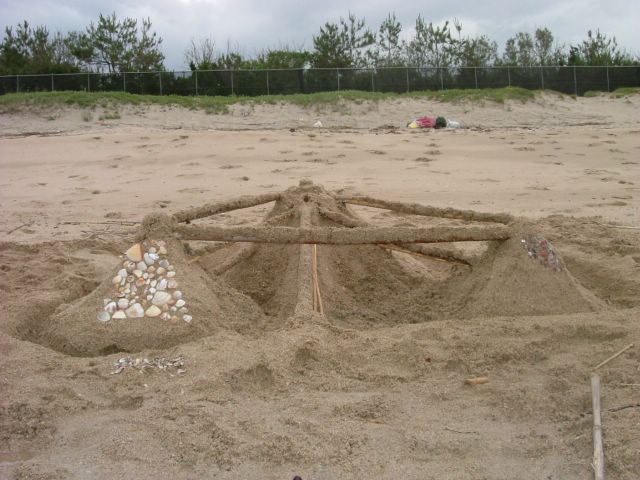
At the moment the tide recedes, these giants of crushed shells and unmade stone plead to emerge from the bubbles that the seafoam left behind. Slowly, rising from the trench that will soon become a moat, the towers form, defiant of the empty flatness in this water-ridden desert.

In handfuls they pile up, a frenzy of protuberance fulfilling the dream of a million specks clamouring to rise from their tabular state, to look down and kiss the breeze that gently pounds on their pretentions. Playfully, she whispers "You do not belong here," and convinces a few with her sirenlike voice to trickle down in sucidal lust.

The towers grow bigger now as they begin to take shape. A door, a window, a courtyard and marble steps. From sand into cement, the walls harden like callous hands; but not to stiffness, for the structure is malleable - not a collosus like the rocks of previous lives, but a payment of the karma begotten by their past unwillingness to budge.

Monuments brought down by hordes of liquid discontent, they rest swayed by the same water that once tore them apart, torn again in the humid embrace of salty oppression, ever coarser, ever finer, ever flatter in defeat.

Wednesday, June 15, 2005

Japan IO

Quaint quarries on the way to Tensui

The cliché goes that Japan is a country of contradictions, a melting pot of East and West where traditions collide in Zenlike harmony. Native and foreign elements are perceived as complementary, and adjectives for the resulting combination may hover around anything from fascinating to anachronistic. Many will be ready to point out the dissonance of old and new, the cunning alloy of Western wit and Eastern wile. Japan, they say, still retains its Asian soul amidst cold industrial technology. Yet, despite its cultural schizophrenia—or perhaps because of it—Japan is not so much an incongruous country as it is a place ruled by binary opposition.

Japan does retain many traditions and faux pieces of culture, if not for the sake of authenticity, at least to cling to a romantic image of a "pure" Japan that never was. Many famous Japanese cultural symbols are political creations of the late Edo (Tokugawa) and early Meiji periods, roughly between 1850-1900 and analogous to the height of Western imperialism. They are based less on real tradition than a bid to establish a national identity to secure national unity.

It was during this period that Kabuki theatre, once a persecuted and vulgar form of art, was raised to highbrow status as delineative of the ‘Japanese spirit’ - this despite the rebelliousness and social critique underlying many Kabuki themes. The newly acquired state religion, State Shinto, managed to take local animistic rites and put them in a national scope, all the while creating new rituals to exacerbate the myth of Japan as a monolithic entity. Ancient books, such as the Kojiki (a collection of mythology from circa 1200 AD and roughly a Japanese equivalent to Homer’s Illyad), were used as a base for the newfangled national faith. Even though the country as a unified whole is a relatively recent idea, the Meiji oligarchs endeavoured to give Japan millenary legitimacy through a mishmash of cultural and religious forms, and they exist until these days as national symbols.

The above is not always easy to reconcile with the modern highways, mobile phones and capitalist consumerism that describe Japan in the present. In turn, nationalist sentiments and institutionalised xenophobia have further helped to forge a widespread concept of cultural absolutes, where things are either Japanese or foreign in nature.

Nativism is not a new phenomenon in Japan, and its society reveals a deep nationwide concern with cultural purity. It comes as no surprise that one of the most favoured adjectives by many Japanese–especially those who speak English—is “Japanese,” as though the word itself carried a significant descriptive weight. It can be seen, read and heard everywhere, from tourist pamphlets evoking that elusive ‘spirit of Japaneseness’, Yamato damashii, to pop music lyrics (such as a recent hit titled “Japanese girl”) or endless conversations about ‘Japanese’ tea and ‘Japanese’ cherry blossoms.

Since trying to define what exactly constitutes being Japanese is tricky, it is easier to establish what is not Japanese instead. Thus cherry blossoms and green tea belong to Japan, because highways, mobile phones and capitalism do not. If the latter are of higher quality than in the West, it is only because they are imbued with abstractions, such as the Yamato damashii.

Yet all these arguments start sounding dubious if we consider that most cultural legacies are almost never engendered through singularities, but a buildup of numerous traditions, generally from different places. They borrow from one another, in turn giving form to separate expressions of folklore. Just as Zen Buddhism –a defining theme in many traditional Japanese art forms- is founded in traditions from China and India, modern-day Japanese capitalism borrows heavily from North American and European models. Even cherry blossoms are native to several countries. The concept of cultural absolutes, then, vanishes in between the grayscale shades of critical debate.

Due to reasons both historical as they are political, however, and an educational system lacking in discussion, focused instead on correct/incorrect answers, a large number of Japanese end up perceiving their country not as a mere state-governed physical location, but rather a state of mind. Japan is as much a name as it is a feeling, pride conjoined with deep nostalgia for the old furusato (village), that mythical commonplace of virginal kimono clad maidens performing tea ceremonies for stern samurais. Binary logic has, in short, made Japan a stereotype of itself. And while the preservation of cultural legacy is a legitimate endeavour, history has shown how dangerous equating concepts of nation, race and culture can be.

Japan is indeed a melting pot of contradictions, but only because of the antipodean struggle to separate the native from the foreign, even when these boundaries are oftentimes imaginary. It might not provide seamless harmony, but certainly paves the way for more similar clichés.

Tuesday, June 14, 2005

The Silence Breaks

Blogging Again - and this time it's personal.

One of the best cliches in writing must be starting one's piece stating the present time. "It's 12am now...", and off we go with the day's rant. I don't know why, but it happens, especially in emails. It's the written equivalent of talking about the weather - politely informative, yet not necessarily conducive to anything worthwhile. And just like weather talk can fill in awkward gaps in conversation, stating the time provides a good resort for the uninspired author. "It's 3:30pm and I'm washing the dog"; "1:43am. I am tired." Genius.

Truth is, I was having a bit of trouble trying to come up with something to update the site - especially after over half a year of glacial electronic silence. And good starting lines are scarce these days. So, at the risk of sounding trite, I was about to pull a timey myself for this article. But then I realised that the old timelog gambit would only make for a sublimely dull piece. Overall, it would've looked something like this:

1:21am - I am writing an update for my weblog.
1:23am - Still writing.
1:26am - Still writing.
1:35am - Scrounging for ideas, but still writing.
1:41am - Hey, a cockroach.
1:42am - Still writing.
1:50am - Yup. Still here.

Luckily it didn't!

Thursday, October 28, 2004

Because I may Dream of Butterflies


Being fluent in Japanese does not require speaking the language. Learn all about it in the newest article - My Inept Proficiency. If you can be bothered, that is.

Sunday, August 22, 2004

Miniature landscapes call for miniature updates


A miniature landscape representing mount Fuji at Suizenji Park, Kumamoto

Excellent Simpsons quote from an episode I just watched: "I'm a rageoholic! I just can't live without rageohol!"

Incidentally, check out my latest article. It isn't funny, but then again nothing else around here is anyway - besides my head, perhaps.

Thursday, August 12, 2004

Of Embers and Sand


I just came back from Miyazaki today, after a weekend of fun and frolics at the beach. I left for Kagoshima on Saturday with a few acquaintances and arrived to the beautiful (for Japan, that is) Akune beach -a popular place among young people, surfers and families, and one of the few beaches in the country that has escped being walled up in concrete for no reason ("Ah, what a beautiful place. Quick! Let's bulldoze it and cover it up in cement!"). I later came to realise, of course, that the place is not so popular with families and young people as it is popular with /some/ families and certain breeds of young people. A tacky ramshackle structure stands at the entrance with floaters in the shape of animals for rent and the despicable whirring of jetski motors faded behind a speaker blaring awful pop music made the place look like a cheaper version of your most horrible seaside town prejudices. Only that there was no town. Or waves, for that matter. I am still debating whether I unwittingly went to a lake instead.

However, I decided to take it all at face value with a smile and had fun regardless. I was even lured into riding a "sea biscuit" (aka "the Raping Arse-Punisher"), a strange floating contraption pulled at high speeds by a jetski, in a fashion similar to water skiing, but sitting down. The speed and the pressure are such that one's arse is sucked into the sitting hole while angry splashes of trapped water pound it with the might of ten thousand sledgehammers. Like an irritated 200lb Russian masseuse wearing a clown suit, it was as amusing as it was painful. I can see the adverts
already -"Try our Sea Biscuit: the fun game that will make you want to scream!"

In the afternoon the people I was with went back to Kumamoto, and I decided to take a train to Kagoshima city. I spent most of my time there getting caned on top of a concrete structure at the port facing Sakurajima (an active volcano forever looming across the water in a sort of ominous final countdown), watching a firework show and eating pizza. I sat there doing nothing in particular, thinking strange thoughts while I waited for my friend, who was scheduled to arrive later that evening. Hours later, after meeting up with him, we went out exploring the nightlife of Kagoshima.

Kagoshima -or Satsuma, as it was known in times past- is both the the heart of an old and powerful fiefdom and the historical birthplace of the famous Satsuma rebellion that took place in the late 1800s. As would be expected, the place is littered with graves and even a "monument to great men" (I jest you not, this is the official name) for the thousands upon thousands that have died at some time or other in Satsuma. Now, I don't know if it is the lingering feelings of inevitable doom waiting patiently behind the toxic fumes of Sakurajima or the anxious fear of yet another rebellion ravaging their homeland, but the people of Kagoshima have either not been reproducing with the same zest of other Japanese cities or they have become too scared to leave their houses. Whatever the reasons might be, I have only one thing to say: I have seen livelier funerals and mass sepulcres.

With my eensy weed stash at an end, whate else could we do but get very pissed at a random bar nearby? Luckily the barman liked us and let us stay there drinking for free all night as long as we entertained his customers by speaking English and, well, being gaijins; it was a good choice of place too -there were almost five people in there!

The next day, after suffering from a throbbing hangover and venturing into a waveless beach on the other side of Kyushu we decided to go to Miyazaki instead, prompted by a dude at a surf shop. Down in Miyazaki I met lots of new people and managed to do some surfing (if it can be called that - "falling over pathetically and almost knocking myself unconscious with the board" might be more appropriate). We camped on the beach. Adam made a bonfire while I created a tent out of driftwood and plastic to shelter us from the rain that night. Of course it didn't work and we still got soaked, but it was fun pretending that it would nonetheless.

I'm out of witty comments and sarcastic remarks so I'll edit this later.

Friday, July 23, 2004

Trigger Happy


The sun shining behind the trees at Taburazaka.

The Photo Gallery is now available. By all means, mosey on over.

Monday, July 19, 2004

Isn't it Unfortunate, Don't You Think?

If you are a young twenty-something who has just lost the chip on his shoulder, the first two things that may pop to mind when asked to remember the mid-1990s are angst and thick flannel shirts. Musically speaking, it was an age marked by Dr. Marten's and Seattle garage bands, lyrics littered with excess-fuelled faux depression and bad poetry. Or perhaps you were a victim to the incessant whining of Britpop melodies and clean guitar riffs peppered with prozac. The 1990s was the decade angst became a consumer commodity.

Slowly, as the years went by, like a creeping spider on a heroin-stained wall, we began to see a lot of the accumulated pessimism switch sides on the gender scale. Coupling with a hateful breed of 'girl power’ mentality, it would later spiral catastrophically to create an angry slew of self-righteous femiangst singers. It wasn’t long until we were surrounded by an entourage of fair maidens strumming to 'outrageous' and 'honest' lyrics, all of them charged with the spite of ten thousand scorned Medeas.

Between these women, the name Alanis Morrisette springs up faster than a psychiatrist's recliner. Her tawdry ballads of unlove hit a nerve with the millions of teenage girls who, up to that point, had not found a proper outlet for their crushed dreams of romantic crash and burn. What is more, it is thanks to Alanis that a whole generation of young people do not understand the real meaning of the word "ironic", as wrongly evoked in her catchy yet most unfortunate song of the same name.

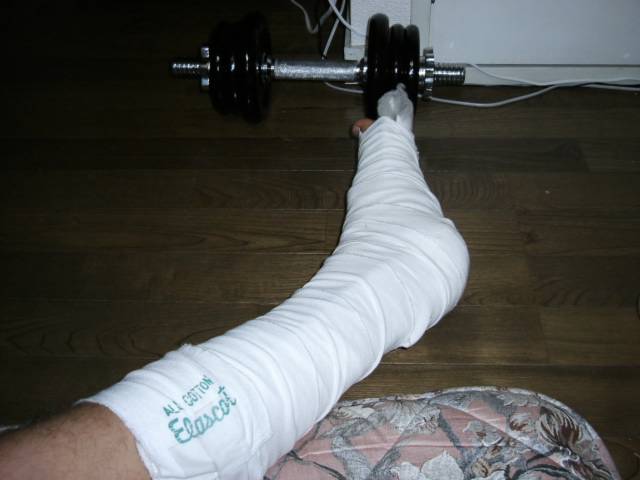
You might be wondering where I’m going with all this. You see, be it irony, opposition of terms or just sheer bad luck, I cannot help but imagine the recent events in my life would make perfect fodder for an Alanis Morrisette song. I fell off the stairs at work and, well, you can imagine. A big cast, a swollen left foot, ruined holidays, the whole caboodle ensued. Not only that, but the cruel Morrisette-branded irony resides in that the fracture was a product of my own attempts to watch out for my right foot, which had been stupidly stung by a mukade centipede the day before. So, on Friday I was confronted with two sadistic choices of movement: either on a painful, swollen black foot or on an itchy, swollen red foot. The tragicomedy was priceless. A bit like your local priest telling you that Jesus actually hates you.

Fortunately my itchy foot has almost returned to its normal dainty size by now, after a weekend of bouncing up and down on crutches and riding the occasional wheelchair. And since my other foot is broken, the company has lent me the company car to use whenever I want. How could I let such an opportunity pass?

A new world of unseen vistas waits out there. Besides, no matter how remote, how backward or how desolate an area might seem in Japan, there are always hidden things to amaze and confuse the unwary, usually taking the form of a temple here, some ruins there, or a Pachinko parlour a bit further up the road. The possibilities are endless.

The Japanese countryside –what is left of it, at least- is daubed with a distinctive kind of beauty. The rolling landscape of the Aso range looms impassive under picture-perfect clouds, their moving shadows cast on brightly coloured mountainsides. It is then when Japan shapeshifts into a beautiful Irish meadow, conjuring deep green from every corner. Moments later the illusion is replaced by that of a lush Patagonian island, its low hills marred by forests and wind. A glimpse of England. The shade of towering cornstalks and scarcely placed buildings become a suburban desert in the North American south. If you look closely enough, myriad destinies lurk beneath the verdant hinterland of Japan.

But the nostalgia only lasts for a second. If you look closely again, you begin thinking that Irish hills are lower and that the light here is too intense. You remember the grave hues of Patagonia are different, deeper, not as bright. The English prairies vanish. In between the cornstalks you start wondering how narrow and winding the roads are, how well marked everything is -and all in Japanese, too.

The truth is that American, Irish, English, Chilean or whatnot, there is always something else flickering, candlelike, in the background. It is the rural chaos amidst urban order. It is the cruel savagery of intensely apologetic drivers. It is a rain cloud in the shape of an Ukiyoe girl, or an inviting but impenetrable bamboo forest. A landscape so alienating and contradictory, yet so alluring at the same time.

And here I am, faced by contradictions of my own. I finally have a car to go wherever I want, yet I cannot go. I am forced to stare passively from the other side of the windshield, my faithful crutches keeping me company on the passenger's seat. The scenery winks coquettishly, luring me in like a hungry Siren whose appetite lasts only until the end of the road; soon after, the landscape becomes a zealous guard who straightens an arm and rudely orders me to halt. I cannot tread on the woodland beyond, and I cannot climb the inviting rocks behind the trees. I can never know the inner secrets of the forest. Tachiiri kinshi. "How Japanese," I cackle to myself with resignation.

But life goes on, and the landscape soon forgets that someday I will walk again. Only then, just when its doors have been opened, the mountains will remain stoical, unreachable in the background, calling from afar like a damsel in distress, ready to offer her voluptuous graces as a prize. Alanis Morrisette would definitely call it ironic. I just call it unfortunate.

And so I sigh and pour myself another cup of insipid green tea.
Heart of Darkness aka The Beauty and the Beast


Beautiful. Just beautiful. My heart warms.

Monday, May 31, 2004


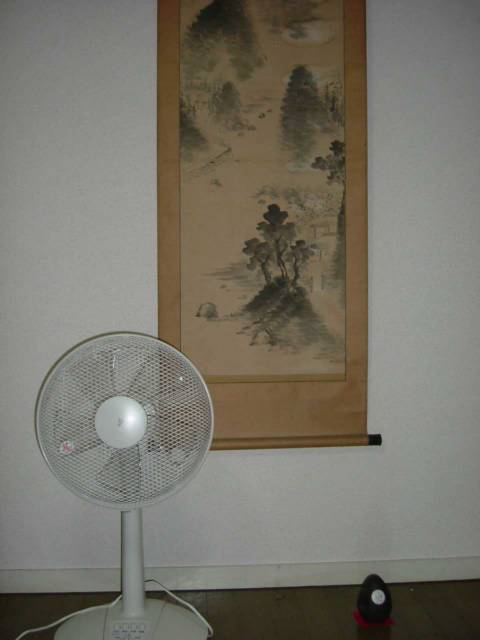
It's hot today. It's been hot for days now. And it's all downhill from now on -the rainy season starts officially this week and nature, as though mocking human weathermonging arrogance, has been lashing at us by sending forth hordes of humidity and stifling heat. And yet it is but a small taste of what is to come, or so it has been repeatedly advertised to me by more than one anxious-looking Nihonjin. As I write, the mighty whoosh of my newly-bought fan gales against my face at full blast. I have reason to believe that this scenario will be repeating itself pretty often.

Sunday, May 30, 2004


A smoky erection at Honmyouji. Posted by Hello